


For those looking to install solar and for those who already have solar or batteries, knowing how their electric company will handle the excess energy produced by the system is very important. This will not only determine their monthly electric bill but, also how long it will take to break even on the system and the calculations of the Return on investment (ROI).
Net-metering, and its younger brother the Buy-back program, are the billing methods used by the Retail Electric Provider (REP). These set the price of KWh your system pushes into the grid and the price per KWh your house pulls from the grid. This can be accomplished with either two electric meters, one recording the KWh consumed and another recording the KWh exported, or with one meter able to add and subtract according to the flow of KWh. This is known as spinning the meter backwards. At the end of the billing cycle, the customer is billed for the net KWh consumed by subtracting the two numbers or by reading the single meter final number.
If the price of exported KWh is the same as the imported KWh then this is known as the traditional Net-metering, some people may call it “One-to-one Buy-back”. This is the original and still the best agreement that the customer can have with his or her electric provider. If the imported or bought KWh is priced different from the exported or sold KWh then this is a traditional Buy-back program. There are different models of buy-back programs, and all of them attempt to reflect the reality of the electricity delivery business, so they are less generous to the consumer.
Background
Every KWh your home consumes, your REP is selling it to you and they need to buy at a lower cost in order to turn a profit. In Texas the price of retail KWh varies from $0.09 in the low end up to $0.25 in the high end. If you live in a de-regulated area then you can choose the REP with the best price or program for you. If you live in a regulated area where there is a single electric retailer then you are limited to the programs that REP offers.
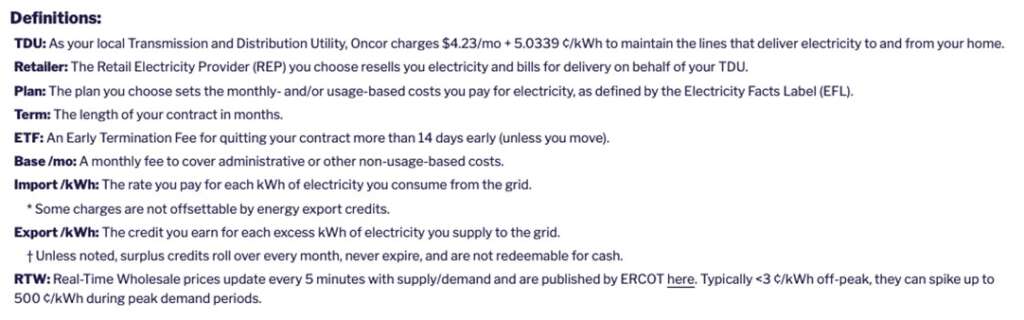
Retailers buy electricity from the grid using either the Avoided Cost method or Real-Time Wholesale (RTW) method. The latter is instantaneous varying every 5 minutes, the former is based on preceding year’s average price. They also need to pay for the delivery of that power and the maintenance of the lines, that is done by your Transmission and Distribution Utility (TDU). In north Texas that is ONCOR; in Houston that is Center Point. The rest of the state has several more TDUs. ONCOR charges your REP for TDU, whether in a regulated or de-regulated area, a minimal monthly base plus about $0.05 per KWh delivered. The REP combines the RTW, TDU, their own operations cost and a profit to then set the price per KWh that they offer to consumers.
What is common to both Net-metering and Buy-back?
There are several conditions that apply to both programs. For example, both could allow bill credits to be carried forward to the following month’s bill or not. When credits are carried from month to month these may be carried until the end of the year or until service is cancelled. At the end of the year the credits could expire, or could be converted to real money in the form of a check to you. Additionally, both programs can offer price of KWh based on peak/off-peak or free nights and weekends. Both may have a monthly base charge or a minimum monthly bill.
To recap, both programs may allow bill credits to be carried forward and some will not. Either of these may have limits on how long credits can be carried and some may have cash out options; some may have time-of-use (TOU) rates and some are fixed.
Now let’s see what specific of each program
Net-metering characteristics
As we said earlier, in Net-metering the cost of imported and exported KWh is equal and does not change for the duration of the contract, this is fixed pricing. This program is favorable to solar systems without batteries which produce as much energy as the building consumes or slightly more. This program is also good for oversized systems as long as bill credits can be carried forward or if they have a cash out option. Traditional Net-metering (One-to-one buy back) is the best program for a shorter payback time and best ROI.
Net-metering plans usually have either a base monthly payment or a minimum bill. Use caution when calculating ROI using one-to-one KWh prices because there are few of these plans and they tend to go away as the market area gets saturated with solar.
Buy-back programs with fixed rates
Under this program the rate of KWh bought and KWh sold are different but fixed for the duration of the contract. The price of KWh sold (pushed to the grid) is typically from half to one third of the price of KWh imported (pulled from the grid). These agreements are good for undersized solar only systems and for solar plus batteries systems when the excess energy is stored for later use instead of pushed to the grid. The break-even time is extended under these plans and the ROI is small compared to Net-metering.
These plans can also offer free nights and weekends but then the price of imported KWh during the day typically doubles compared to other programs. If you are able to shift power consumption to nights and weekends leaving your solar system pushing KWh to the grid during the day, even at a reduced rate, it may be worth to you.
Using an example to describe how these programs calculate the bill at the end of cycle: Let’s assume you have an 8 KW PV system which produces in average 32 KWh per day and the bulk of that production is done between the hours of 10 AM and 3 PM. During that time your system may push 20KWh to the grid because the other 12KWh were used by your house during the same time period:
Excess energy = Production – Consumption
Excess energy = 32KWh – 12Kwh = 20KWh
Outside of the hours of 10 AM to 3 PM, when solar production is low to none, your house will importing power from the grid, let’s assume 20 KWh total for a 24-hour period. In a Net-metering plan this would result in a 0 KWh net consumed and $0.00 Bill. In a Buy-back program where the imported KWh is priced at $0.15 and the exported KWh is priced at $0.075 the net bill for that one day would be $1.50 despite having the same net KWh use of 0 KWh. The formula for a fix Buy-back bill calculation is:
Net KWh charge = (Imported KWh X Import rate) – (Exported KWh X Export rate)
Net KWh charge = (20 X $0.15) – (20 X. $0. 075)
Net KWh charge = 3 – 1.5 = $1.5
Average one day KWh cost = $1.50
Typical electric monthly bill = $45.00 + Fees
Buy-back programs with variable rates
Buy-back with variable rate programs have a fixed import rate and an export rate that varies either with the time of the day or according to the wholesale market rate which is driven by grid supply and demand of electricity. Time of day rates are also called “Peak / Off-peak” rates. The peak time is set by each REP independently, but it’s usually from late afternoon to early evening or from 3:00 to 8 PM week days, and off-peak is everything else.
The other variable that can be used to calculate the export rate is called Real-Time Wholesale (RTW). This value is published in Texas by ERCOT every 5 minutes and can vary form a negative number up to $5.00 per KWh during an energy crisis. This variable is tied to demand versus available power. RTW is usually at around $0.03 KWh or below during low power demand like at mid-night when most people are sleeping or at mid-day when solar PV production is at its highest.
A typical high RTW would happen in the summer months between 5 and 7 PM and in the winter months during artic cold fronts in North Texas which last a couple of days typically.
These programs are good for solar plus storage system where the solar overproduction during the day is stored and used during the evenings, thus, minimizing the energy exported to the grid. These programs have the longest breakeven time and offer minimum ROI for solar only systems.
Sample programs in North Texas De-regulated areas
In the de-regulated areas of North Texas which is mainly the densely populated Tarrant and Dallas counties, you will have choice of several plans offered by an overwhelming number of retail providers. To simply the search we recommend using the outstanding data compilation from Texas Power Guide, which is an independent research group gathering data in this topic for many years. The table below is coming directly for their site at: https://www.texaspowerguide.com/solar-buyback-plans-texas/
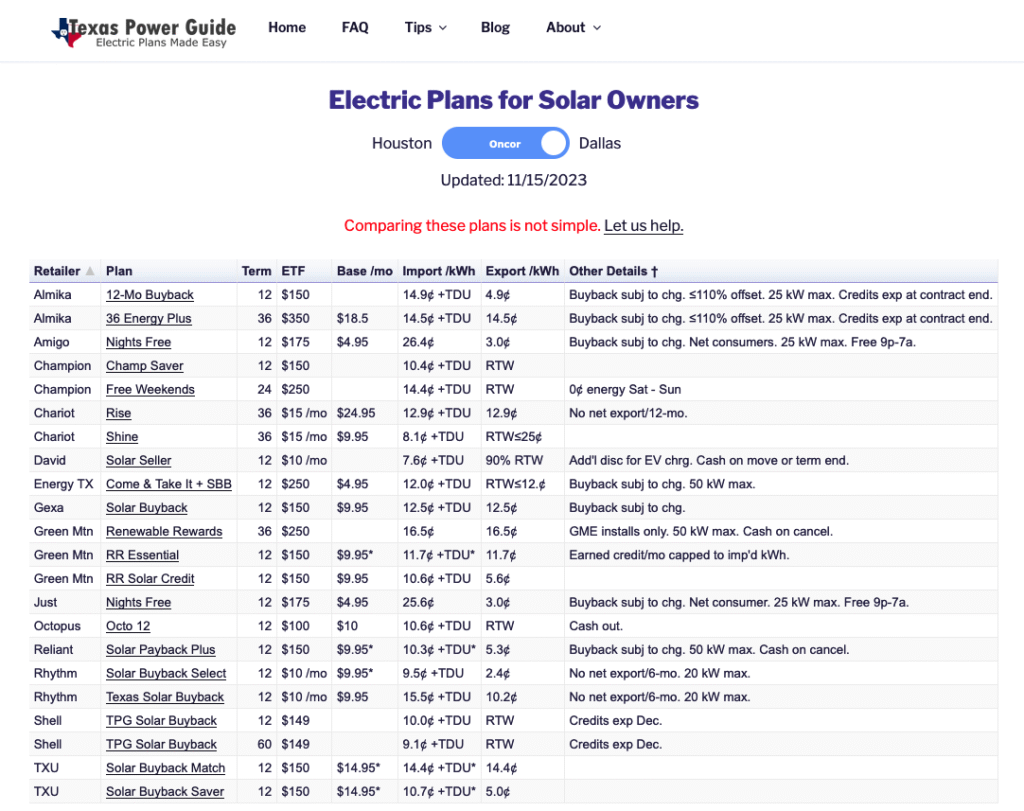
From that table I want to highlight what I think is the best program. That is the “Renewable Rewards” plan from Green Mountain Energy. This is a Net-metering plan with a buy and sell rate of $0.165 per KWh with no monthly base fee. The only issue I find with this plan is that it has a long 36-month contract with an early cancellation fee of $250. It should be perfect for oversized solar systems.
The second-best plan could be TXU’s “Solar Buyback Match” plan which is not a Net-metering plan but has a high export price. If we factor a Transmission and Distribution Utility (TDU) cost of $0.05 then the import rate is $0.194 and the export is $0.144. And this plan is a standard 12-month contract.
Sample programs in North Texas Regulated areas
The regulated areas of North Texas is serviced by several electric co-operatives. The most populated suburban counties of Denton and Collin are serviced by four Co-ops: CoServe Electric, Fannin County EC, Farmers EC and Grayson County EC.
Out of these only Grayson County (GCEC) offers a true Net-metering program. For information about their plans visit: https://www.gcec.net/
CoServe Electric Offers a Buy-back program with a fixed rate of $0.0626 per exported KWh. For information visit: https://www.coserv.com/energy-solutions/solar/solar-installations/
Fannin County EC also offers a Buy-back program with a fixed export rate, in their case it is $0.071972 per KWh. For information visit: https://www.fanninec.coop/services/distributed-generation/
Farmers EC offers a Buy-back program with variable export price using “Avoided Cost”, which is equal to the preceding calendar year’s average cost of wholesale power. For information visit: https://farmerselectric.coop/solar-power/
Bonus material - Virtual Power Plants (VPP)
If you have an Energy Storage System (ESS) you may be able to recover the cost of it faster by participating in a VPP. These are programs offered by a couple of retail providers which coordinate the discharge of your batteries, with some limits, into the grid when the RTW is very high. By doing this with hundreds of participating customers simultaneously the REP acts as a special type of power generating plant called a “Peaker Plant”. These plants are used to rapidly increase available power in the grid during high demand. Consequentially, at these times is when the wholesale price of KWh (RTW) is the highest which creates an additional profit opportunity for the REP and you, the owner of the ESS.
Tesla Electric, a new REP and a branch of the electric car maker, which also manufactures ESS systems is offering electric plans with VPP options. Unfortunately, Tesla Electric like Octopus Electric, another REP offering VPP plans, only operate in the de-regulated areas of Texas.
According to a press release from the Public Utility Commission of Texas, dated August 23rd 2023, there are eight more REP in the process of certifying their VPP solutions with the Texas grid, so there will be more VPP options soon.
Closing comments
As you can tell Net-metering is strait forward and plainly, the most beneficial when calculating payback time and ROI. If you live in a de-regulated area of Texas, then more work is needed to analyze average consumption, system overproduction, import and export rates, length of contract and others to find the best plan for your situation. In general Buy-back plans will come with longer payback time and lower ROI. Now, if you have the early-adopter mentality, you may want to try some VPP plans to get extra use from your home energy storage system while helping the grid and VPP providers improve their plan offerings.


