

The short answer is: It depends on who owns the system
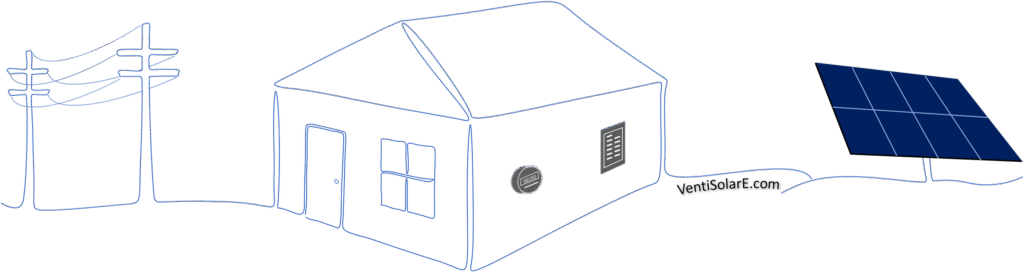
In a PV lease or PPA (Power Purchase Agreement) the installer company, or one of its associates, owns the system and they give you access to its power production for a price. Thus, the home or business owner where the system is installed does not invest, nor receive a return on investment (ROI).
Venti Tech Solar doesn’t offer solar leases or PPA. We believe this business model is outdated and, in most cases, it only benefit the leasing company leaving the solar leaser with all the financial burden and inconvenience.
Now, if you own the PV system either because you paid cash for it or you financed it then, you are an investor and you receive ROI in more than one way. Let’s see some of them:
Federal income tax credit
Due to the recently signed federal law called Inflation Reduction Act, the owner of the solar PV system can claim 30% of the total cost of the system as a credit against his or her income tax liability the following next year. And if the credit is greater that the tax liability of that year it is possible to carry over the remainder to the next calendar year until the whole 30% is claimed or the end of the year 2034 when the current law tax credit expires.
For most Americans this is a sure 30% discount on the cost of the system, but you get a whole new PV system, not 70% of it. In other words, the PV system owner is 30 points up on its investment from day one. To that discount you can add local incentives and available utility rebates which further reduce the cost of the investment.
Increased Home value
Yes, everyone’s situation is different but, as a general rule homes with solar PV systems are more desirable and thus can be sold for a small premium compared to similar homes without solar PV systems. How much more? It could be anywhere from 2% to 4% in Texas. But don’t take our word for it. The research came from Zillow, the company whose core business is home valuations. In most cases the added value is greater than the cost of the solar PV itself. The new home value can be used to cover the payoff balance of the solar loan on situations where the homeowner needs to leave the home halfway through the solar loan terms.
Interesting enough, this additional home value only applies to PV systems which are owned (cash or loans) but not to solar leases or PPAs, which work on the opposite, reducing the desirability of a home, and thus, complicating the sale or lowering the sale price.
Another perk of PV systems as an investment regarding home valuations is that the added value cannot be used for calculating property taxes in Texas. In other words, it adds value to a home but, the added value is not taxed annually by the local tax appraisal jurisdiction. This is the law of the land in Texas and other states.
Long term production
Another reason why a solar PV system is an investment is because like any good investment, its cost is lower than the return from it. In other words, the value of what you get from it is higher than its cost.
The lifetime of a solar PV system more than 30 years. With most of them having a 25-year production warranty. That means that the manufacturer of the solar panels warranties that their panels will produce at least 85% of their rated power at the 25-year mark. Some high-end panels have a 90% production warranty for the same time frame.
With that in mind plus the specifications of a solar PV system we can calculate the lifetime electricity production of the system. And once we have that number we can multiply it by the cost of electricity in your location. In this way we will have a monetary value of the energy produced by the system during its life span.
Let’s analyze an example: Let’s review the return on investment (ROI) of a grid-connected, roof mounted, 8 kw PV system installed in north Texas (33 degree latitude). For simplicity let’s assume that all its panels are aligned to true south. A turnkey system like this, without backup batteries, would cost from $17,000 to $23,000 before incentives and federal tax credit, depending on labor and materials. Let’s use a mid-range value of $20,000 before incentives and tax credit. Subtracting the recently increased 30% federal tax credit the system would cost $14,000 net.
The following table details the return on investment using 13.6 cents per kw/h as the utility rate. We are also assuming that the PV system covers over 90% of the homeowner’s electric needs.
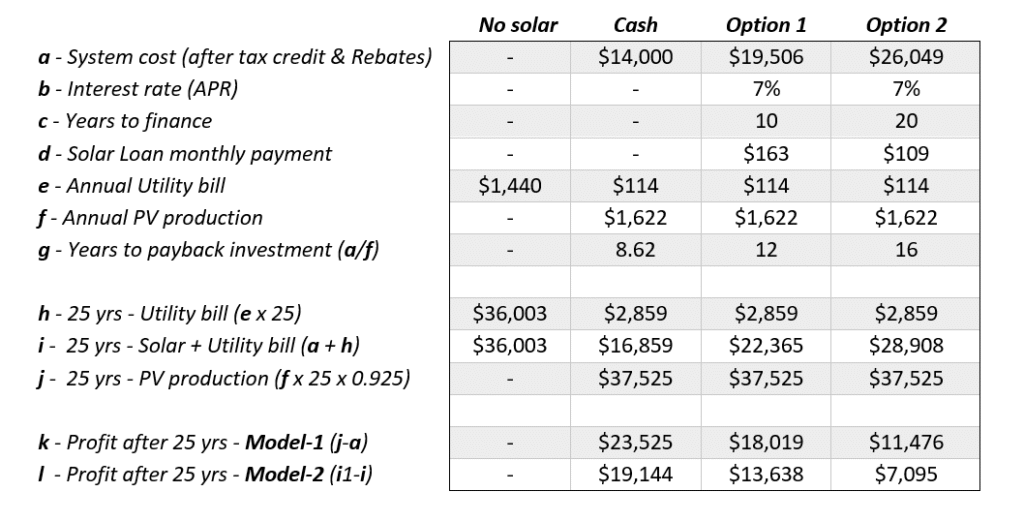
Let’s examine the two methods to calculate ROI used in the table
Model-1: In this model the ROI is calculated by subtracting the total system production from the system cost. This method is used when the utility company pays for extra power generated by the homeowner and the price per kw/h is the same for buying and selling.
Model-2: In this model the ROI is calculated by subtracting the combined utility bill plus solar PV system cost from the total cost of electricity after 25 years without solar. This would account for the times when extra power was produced and fed to the grid, but no compensation was given.
Using model-2 of calculating the ROI and if the customer paid cash for this system, we can estimate that the ROI would be $19,144. In other words, the cost of the PV system plus the remaining utility bill for 25 years was $16,859. That is the cost of covering this customer’s electric needs for 25 years. If we subtract this number from the cost of electricity without having a PV system we see a savings of $19,144. ($36,003 – $16,859 = $19,144)
Again, using model-2 but financing the system for 20 years at 7% interest the system would cost $26,049. Following the same formula, the ROI would be $7,095. In other words, the PV system plus electric bill totals $28,909, then we subtract this number from the cost of electricity without solar PV and we get $7,095 ($36,003 – $28,908 = $7,095).
This computation leaves out several factors, like the cost of electricity increasing over the 25 years, increasing or decreasing energy needs of the homeowner and others.