Energy Storage

Call us

945-333-0040

Guide to Energy Storage Systems (ESS) - Home batteries

Solar batteries or home batteries can be an overwhelming topic. In this article we explain what they are, how they work and key elements to consider when choosing a system.

An Energy Storage System (ESS) is a collection of devices plus batteries that store electricity for later use. That could be during a power outage, for off-grid living, for solar production self-consumption or to take advantage of favorable electric rates at specific times of the day, which does not require a solar system. These systems are normally called solar batteries because they were attached to a solar PV system or storing electricity generated by a solar panels. That is no longer the rule, thus, the “solar battery” name may not be correct.

There are several ways to classify home batteries or ESS. Here are some of the main classifications: AC versus DC coupled, battery chemistry, capacity, warranty, manufacturer, price, Etc.  Let’s go over some of these.

Coupling, which is better DC or AC?

Coupling refers to how the ESS connects to the solar panels or to your home. Alternating current or AC is used by all appliances in the home, and the electric grid but, at very different voltage. Direct Current or DC is used by solar panels, batteries, cellphones, toys and electric vehicles, in other words, anything with a battery. That is because, batteries (electric ones) can only store energy in direct current (DC).

Both AC coupled and DC coupled ESS solutions store electricity in DC form so, the AC coupled systems just come already with an inverter/rectifier built into the box which converts battery DC power to AC power for use in the house when discharging; and the reverse for charging, converting AC power from the house or grid to DC electricity to store it in the batteries.

DC coupled ESS solutions rely on external inverters to do the conversion. These do not include an inverter. DC coupled systems require a bit more work to design and implements since the battery characteristics need to match the external, third-party charge controller or hybrid inverter that will extract power from the batteries and also charge them. We are talking about voltage, current, battery chemistry, temperature, Etc.

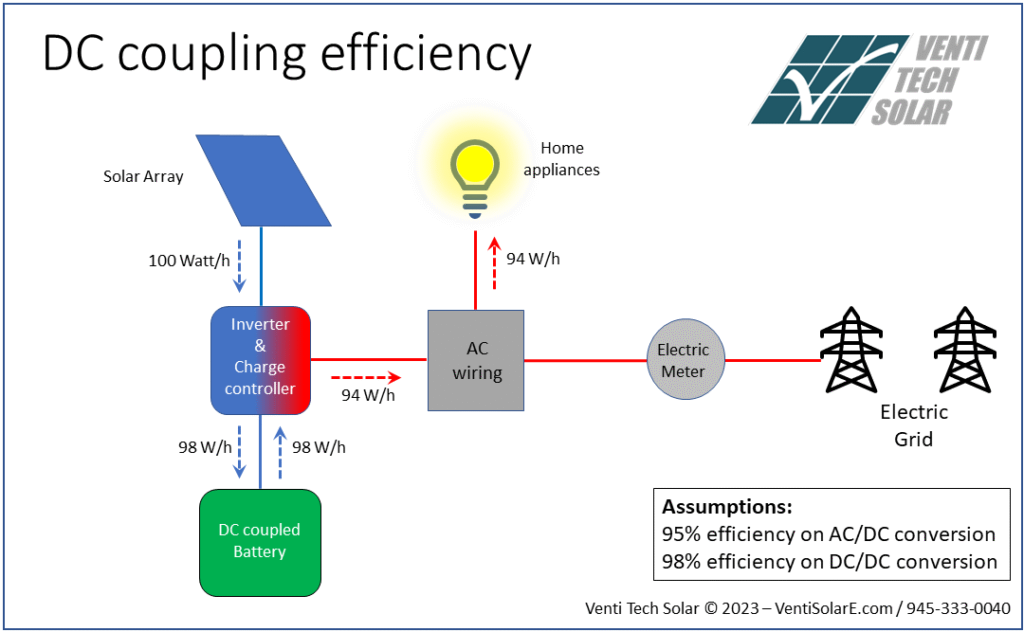
Understanding the difference between DC and AC coupled will rule out a whole set of ESS, leaving in what you can use according to your needs. DC coupled ESS are typically installed when a solar PV is installed since they are difficult to retrofit to an existing solar PV system. The main advantage of DC coupled systems over AC systems is their energy efficiency. Because the power is generated from the solar PV system in DC and stored in DC current there are fewer AC/DC conversions and thus, less energy losses. AC coupled in the other hand are very flexible and can be retrofitted to existing solar PV systems easily or installed without a solar PV system at all. When using an AC coupled ESS store solar energy then there are three AC/DC conversions. One DC-to-AC from the solar panels to the inverter, one AC-to-DC from the inverter or charge controller to the batteries, and lastly one DC-to-AC from the batteries to the home appliance. You can expect AC coupled system to be from 5 to 10 percent less energy efficient than DC coupled systems when storing electricity coming from locally generated sources (solar panels, wind turbines, Etc.). 
Example representation of DC coupling efficiency

The previous image is a representation of the current conversions in an DC coupled system assuming a 5% power loss when converting DC to AC or vice versa and a 2% power loss when converting between DC current of different voltages.

The next image represents the current conversions of an AC coupled system and the power losses along the way. 

Example representation of AC coupling efficiency

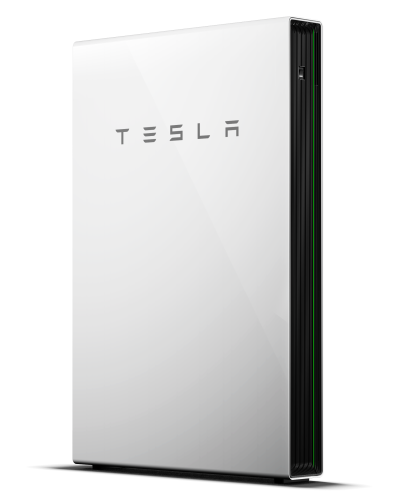
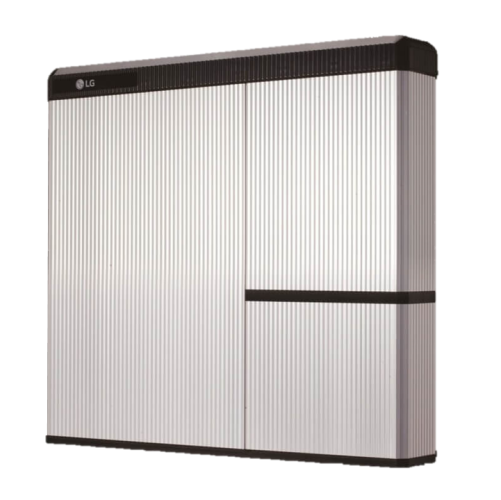
Here are two of the most popular home battery systems in the market. The Tesla power wall which is an AC coupled system and the LG Chem Resu 10H which is a DC coupled system:

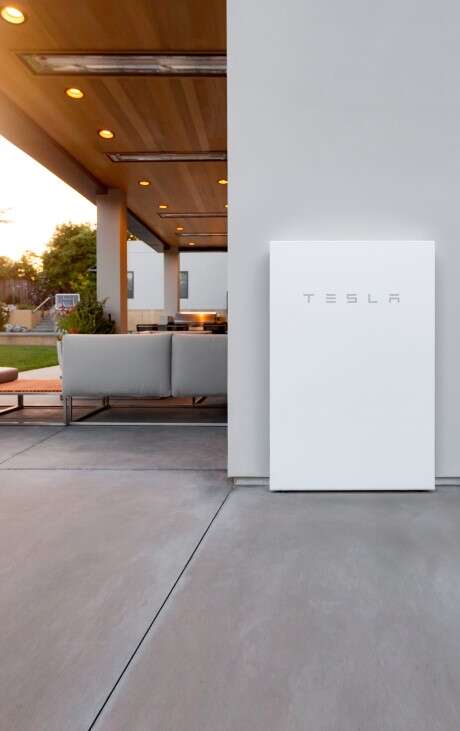
Tesla Powerwall
AC coupled / 13.5 KWh
LG Chem Resu 10H
DC coupled / 9.8 KWh

Now let’s talk about battery chemistry and why it is so important.

Battery chemistry – why is it important?

The elements that make up the cells in the battery are important for more than one reason and often overlooked by the untrained eye.  These elements dictate how long the battery has been in production, its cost of production, ethical concerns, life expectancy of the battery and/or how many cycles of charge/discharge can be expected of a battery before it needs to be replaced. And or course, how safe it is.

In the last 30 years scientist have made fantastic progress increasing the amount of energy that can be accumulated in Lithium in combination with other materials, like Carbon, Nickel, Phosphate, aluminum, manganese, titanate to mention a few but, most importantly Cobalt. All of these metals need to be mined and some pollute the environment more than others. Then, there is Cobalt.

The use of Cobalt in batteries comes with two main problems. For once, it is mostly mined in unethical conditions in countries with poor human rights track record, polluting the environment and negatively affecting the health of miners. The second important issue with Cobalt use in batteries is that it lowers the temperature at which thermal runaway starts (410oF). Plainly put Cobalt increases the chances of fires in specific situations. Cobalt is used in the Tesla Powerwall which uses NMC chemistry cells.

The other most commonly use battery chemistry is LFP or Lithium-Iron-Phosphate (LiFePO4) batteries, using their chemical symbols, also known as Lithium-Ferrous-Phosphate (LFP) using abbreviations. These are batteries have lower energy density than Cobalt based batteries, so they take more space and weight for the same amount of energy storage. These are still lightyears lighter and more energy dense than Lead acid batteries so there is no comparison to them. 

The absence of Cobalt makes a more thermal-runaway resistant battery (518oF for LFP cells). It also makes the resulting battery less costly and more ethically produced. LFP based systems also come with an increased lifespan in charge/discharge cycles, sometimes double the cycles of NMC systems.

Most of Tesla’s new direct competitors today use LFP batteries. They know there are many advantages over NMC and since they are not invested in NMC they were free to build with LFP from the start. Now, some of these competitors have superior products to Tesla only lacking the brand recognition.

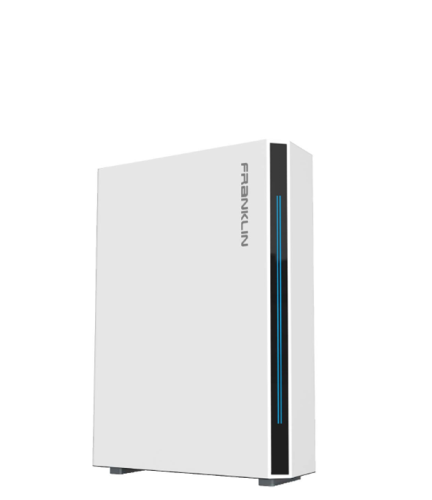
Here are two ESS models using LFP cells:

FranklinWH
AC coupled / 13.6 KWh
sonnenCore
AC coupled / 10 KWh

Energy versus power

The size of the ESS will be determined by the amount of Watt per hour (Wh) or thousands of Wh (kwh) that a system can hold. This is a measure of capacity equivalent to the size of gas tank of a vehicle. Also important is how fast that stored energy can be used at any one time. This is measured in Watts or KW (for thousand Watts) it can also be represented by current (Amps). Don’t worry, knowing the Amps and the Voltage at which the system work you can calculate Watts so, you can compare apples to apples. 

Most appliances in your house will have a Watts per hour rating. For example, if you have a hair dryer with a 1,400 Watts rating (power) and you kept it running for a full hour it will consume 1,400 Wh (energy). If you only use if for 15 minutes it will use 350 Wh. With this information you can calculate how many Watts you need at any time (power) and for how long (Energy).

The common ESS in the market today have a capacity between 5 and 15 KWh, which is sufficient for the average homeowners to backup essential appliances for a day or two in case of power outages. For example, a single Tesla Powerwall has a capacity of 13.5 KWh and the Enphase IQ10 has a capacity of 10 KWh. That is total energy. How long will this energy last you depends on how you use it. The best analogy to represent this topic is to ask “How long will a bottle of water last you If you were lost in a desert for a few days?” Exactly.

Let’s put it all together; assuming that you have a highly efficient air condition unit which is rated at 3,000 Watts and you install the Tesla Powerwall, during a power outrage you will be able to run this A/C unit in a hot day for about 4.5 hours maximum. And that assumes that the A/C unit is equipped with a soft-start switch or variable speed compressor and that nothing else is being used in the house, not even lights. If you factor in other appliances that you want to operate during a power outage, sharing the battery energy then, the A/C unit may only run for a couple of hours before the battery is depleted.

What a bout power? Let’s assume you have two of these A/C units and you want to run them at the same time from the Tesla Powerwall. Since both will require 3 KW at concurrently the power wall will shutdown and both A/C units will stop working. That is because the accumulated 6 KW is greater than the rated power of 5 KW of the Powerwall. Yes, you have 13.5 KWh but you can only use 5 KW at any single time. That is the difference between Energy (KWh) power (Kw).


Manufacturer’s warranty

Here is where the cost of ownership is calculated, the total cost of the system against the expected energy capacity during the life of the system.

In today’s market the ESS industry has settled on a 10 year product warranty with one or other player offering one or two more years. But the years of service is not the only data to consider here. There is also how much aggregate energy can be used from the system to keep it within the warranty parameters. Apart from the aggregate energy some vendors use charge/discharge cycles to measure how much the system was used, and thus, using more cycles than limited by the warranty voids the warranty. And lastly, it is how much capacity is expected of the system at the end of its warranty. Again, the industry has settled with 70% of the initial capacity as acceptable, with a few players offering lower end-of-life capacity in their warranty.  Let’s do some comparison using two ESS products to explain this topic better.

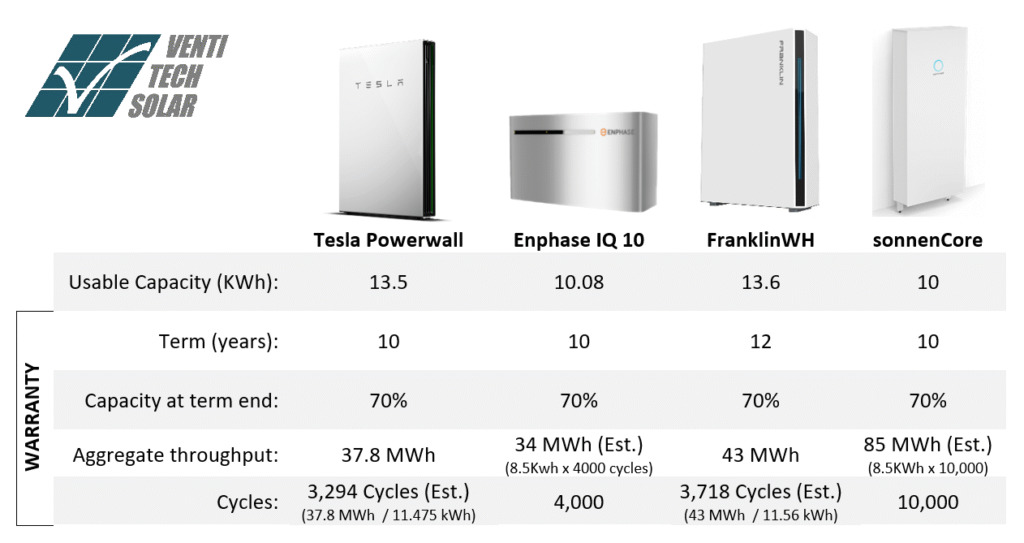
The warranty as stated by Tesla says that the Powerwall should hold a minimum of 70% of its original capacity at the end of 10 years in service. That is 70% of 13.5 KWh or 9.5 KWh. So, you should be able to claim the warranty if your Powerwall doesn’t hold 9.5 KWh at the 10 year mark. Yes but, there is one more requirement stated in the warranty, that is the maximum aggregate throughput should not be more than 37,800 KWh or 37.8 MWh. If you got more than that adding up all the energy used from the Powerwall in 10 years then you are out of warranty.

Let’s do another example using cycles instead of aggregate throughput. The warranty from Sonnen says that their sonnenCore should have a capacity of 70% of its original capacity at the 10 year mark. That is 7 KWh for their 10 KWh system. It also states that should not be more than 10,000 charge/discharge cycles in the same time period. The value here is mind boggling. That means that you could charge/discharge the sonnenCore 2.79 times per day, every day for ten years and still be under warranty. If we convert these parameters to aggregate throughput you get 85,000 KWh (85MWh). We can do that by multiplying the median capacity of the system between the initial capacity and the end of warranty by the number of cycles allowed. In other words:

Median (10 KWh – 7 KWh) x 10,000 = Expected aggregate throughput. Or
8.5 KWh x 10,000 = 85,000 KWh or 85 MWh

Here is a table comparing the warranty terms of four products:

Comparing ESS warranty terms

Federal tax credit

In August of 2022 the Inflation Reduction Act (IRA) was signed into law. In it the government has set aside billions of dollars to tackle climate change and support the deployment of energy efficient systems.

The law allows homeowners and business a reduction of their federal tax liability equal to 30% of the total cost of a solar and battery system. This is not a tax deduction which reduces the taxable income and thus reducing the tax liability, this is a tax credit. In other words, a dollar-for-dollar reduction applied directly to the tax obligation after it is calculated.

A modification to the previous law now allows the same 30% tax credit to ESS systems installed without solar but, the ESS must have a capacity of 3KWh for homeowners and 5KWh for business. It also applies to electrical updates like central loads panel upgrade, re-wiring, new circuits, Etc. Starting on 2023 and until 2032 you can install a battery system for your home with a little help from the federal government. Check our article about  Tax Credit for more details.

Bonus information – Virtual Power Plan

The Texas deregulated electric market is open to any private enterprise, that is to participate as a Retail Electric Provider (REP) or power generator, to mention two. In 2022 Tesla applied and was granted license to join the Texas electricity market. Similar to the Virtual Power Plan (VPP) program that Tesla implemented in California, now Texas is implementing a VPP plan in Texas.

Under the VPP program Tesla acts as a power generation plan by using thousand of homeowner’s Powerwalls and discharging these into the grid at the same time, when the grid is stressed or in emergency events. The business model relies on higher electricity rates, in other words, when there is high demand and low supply. In scenarios like that the Powerwall owners would be compensated in significantly higher rates for the energy they sell compared to the buying rates, more than ten times the buy rate. The program is volunteer based, so you must opt-in the program and allow Tesla to control your Powerwall, discharge and charge it at their discretion to a max of 20% of its capacity.

The benefit to you is that you would recover the cost of the Powerwall faster and feel good about contributing a tiny portion to stabilize the Texas electric grid. Talk about being part of the solution and not the problem.

Tesla is the only VPP program in Texas as of this writing which means that your ESS system needs to be a Tesla Powerwall to participate.
Talk to your Venti Tech Solar representative about home batteries to get detail information including pricing. 

Image cortesy of Tesla

Anatomy of a solar scam

In this article we will explain most scams used by solar companies or solar salesman in today’s market, from the obvious, harmful and plain criminal,

Read More »

Why go solar in Texas?

For some people the main reason is reducing their carbon footprint. For other others the investment is too good to pass on. There is also

Read More »